The OrphanAGE, Vol. 1.20.a
First Lines
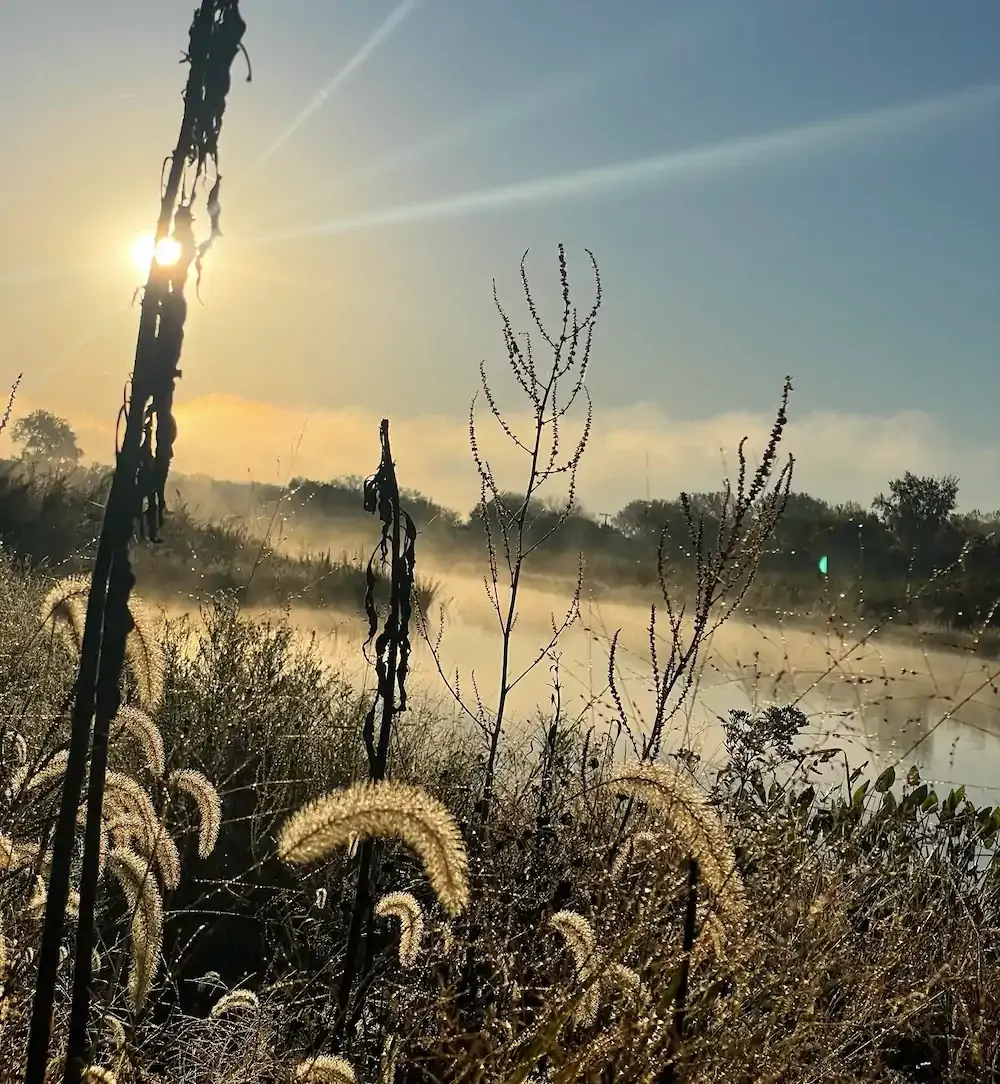
It was about eleven o'clock in the morning, mid October, with the sun not shining and a look of hard wet rain in the clearness of the foothills. — Raymond Chandler, The Big Sleep
What lingers, perseveres beyond the stopwatch of any given life?
Don’t swipe left! This week’s issue offers a first installment of what promises to be a series of fictional encounters via the personals of a city paper, gleaned from a ring-side seat of a mythical, midtown watering hole.
Kelly Chapin-Hagen brings us ceramic impressions of past-present-future femininity, planted for discovery by some future archeologist.
Peace,
Dante
In This Issue:
- Fiction by Bob Moore
- Ceramics by Kelly Chapin-Hagen
Call Me
By Bob Moore
It was a small block ad in the “Marketplace” section of The Pitch the local alternative weekly newspaper. Marketplace occupied the space at the back of the publication that once was home to a burgeoning personal section that provided those who were so inclined a voyeuristic-view into a seamier side of the city: missed connections, hook-ups, “special” services and swinger clubs, to name a few. The new ownership had done away with the section when they took over, not because of its ability to generate revenue, but for the legal entanglements it might spawn.
As Herndon looked at it, the first thought that went through his head was, in these days of the internet, who the hell places personal ads?
But there was one item that was strangely compelling. It was set in a spartan font; Courier, he thought, with an unassuming rule around it. Eight words and a phone number. It read:
Call me. I may be able to help.
The phone number would have been a midtown telephone exchange, when those things meant something. The motivation fascinated him. Perhaps it was it a clever ruse by an attorney to generate work. That at least was much hipper than the
myriad late-night, low-budget television commercials to gig new clients. Perhaps it was some evangelical group looking to surreptitiously lure pregnant girls away from would be abortionists. His long-engrained cynicism would not allow him to think it was just someone who really just wanted to help people.
Perhaps that’s why he picked up the phone and called the number.
A pleasant male voice answered simply by saying, “Hi.”
Somewhat taken aback by the seemingly casual nature of the greeting, Herndon replied in kind, “Hi.”
“Is there something I can help you with?” the voice asked.
Blunted by the good-natured directness he hesitated and then answered, “Well, to be honest, no. I was just curious what this ad and you were all about.”
“Isn’t it obvious? I’m here to help those that I can,” and he hung up.
———
As was his practice, Cooper saved the name and number of the call to his cell contacts. To Herndon’s name he assigned a code consisting of the date followed by a tag reflecting the nature of the call, in this case, CT for “curious tourist.” Having been at this a while, Cooper was keenly aware of the number of gawking tourists who would call out of pure curiosity. He was always polite but never engaged unless a caller was sincerely seeking assistance.
His phone rang again. There was nothing on the caller ID to indicate he had spoken to this party before. As usual, he answered simply by saying, “Hi.”
“Are you the person that placed the ad saying you might be able to help?”
“Indeed I am, call me Cooper, and your name?”
“Uh, Patrick. Sorry, I’m… I’m just not sure about this sort of thing.”
“If by ‘this sort of thing’ you mean call someone you do not know to ask for help, Patrick, I assure you that virtually everyone who calls has the same apprehension. What is the nature of the situation that prompted your call today?”
“Well, uh, I am a sexton at a very traditional Catholic church, North of the city. Are you familiar with what a sexton is? “
“I’m afraid I am not, Patrick?”
“I’m not surprised. I wasn’t either when the pastor asked me to do the job. I’m to oversee maintaining the grounds of the church, including the cemetery.”
“And is it in the execution of your duties that you find need for assistance?”
“Right, but I gotta say that this is very sensitive stuff.”
Patrick encouraged him, “Please, do continue.”
“I’m just not sure I should share this with just anyone.“
“I assure you Patrick, in the nature of the service I provide, confidentiality is essential. My only interest is in being of assistance”
“OK, I guess, but I’m not sure where to begin.”
“Try starting with what is troubling you.”
“Well, one of the more important things I’m asked to do is assign lots in the parish cemetery when someone passes.”
“Understood.”
“Earlier this week, I went to check on an available plot. I inspect the site to be sure there is nothing that would prevent the contractor from opening it and that everything checks out for the grieving family.”
“Of course, that makes sense.”
During my inspection, I was troubled by the thought that the plot was, how shall I put this, not empty. Looking at the plot I couldn’t help but think that it may have been opened before.”
“What specifically caused you to think that?”
“For starters, the hard clay typical around these parts appeared to have been disturbed. Whenever a plot is used, the grass that grows over it looks different than before. I guess that the new growth is thicker.”
“And that is what prompted your concern?”
“Yes, but also the grass itself. I’ve got to say I’m not a professional landscaper, but to me it looked like the grass was much thicker and maybe a different variety. Almost as if it had been sodded.”
“Did you double check the plot map to be sure that the site was available?”
“Yes, that was the first thing I did. And, yes, the map said it was available.”
“I assume you are not inclined to call in the authorities to exhume that plot.”
Patrick panicked, “Oh, my Lord no! I’m afraid that might upset to the entire parish. Is there any way you can think of to help me?”
“I think I might be able to help. Would you be willing to share with me where this plot is located. An in-person inspection might help me discover a solution.”
“I suppose that is necessary. The church is Our Lady of Forgiveness, in Carrollton. It’s about a half an hour drive from the city. Would you want me to meet you there?”
“No, that won’t be necessary, I think it is best if we all remain anonymous. Just put a surveyor’s marker on the plot. I’m assuming the cemetery is not too large for me to locate the spot.”
“Yes, it is quite small. I’ll mark it with a yellow flagged stake.”
“I’ll get back to you no later than tomorrow.”
———
Following the two-hour excursion, Cooper decided a stop at his favorite watering hole was in order. He entered Rudy’s and took up his usual spot by the window furthest from the door. He liked Rudy’s. A neighborhood bar and grill that had been around over 50 years and was still run by Rudy himself. The place was a mainstay. The floor to ceiling windows along the front looked out on 39th Street which was populated with shops, bars and restaurants. The retail strip had been a hub of mercantilism for over 100 years, although in recent times, hardware stores, dry cleaners and butchers had been replaced by coffee bars, smoke shops and specialty food operations.
The surrounding neighborhood was a mixture of upwardly mobile Hispanics, established gay couples and midtown hipsters. Many of the Hispanics had migrated southward over the years from the traditional westside neighborhoods that attracted their parents and grandparents to good paying railroad and meat packing jobs. The gays found the turn of the century craftsman homes that were both affordable and ideal palettes for redesigning ambitions. The young hipsters occupied the plentifully brick-front, three-story walk-up apartment buildings, handy for patronizing the plentiful local tattoo parlors.
Rudy’s was a microcosm of the neighborhood. If you were a DEI aficionado, you couldn’t have cast the help or clientele any better. The server brought Cooper his usual, Pinot Grigio. Rudy stepped out from behind the bar and greeted him at his table.
“Hello my friend, what are you up to today?”
“Just returned from a trip to Carrollton to help someone.”
“Quite a field trip.”
“Oh, it’s not too bad a drive, just under 30 minutes each way…Hey, let me ask you a question.
My recollection is that you did some work with the Corps of Engineers when you were in the service. Did you ever use sonar to examine under a site you were working on.”
“Yes, I did, but the technology was pretty primitive in those days: large, cumbersome and not terribly accurate. Nothing like it is today.”
“How so?”
“These days ground penetrating radar devices or GPR as its referred to are no bigger than a lawn mower and in fact are commonly mistaken for one.”
“Are they complicated to use?”
“Not at all, I actually rented one a few years ago when I was putting in a sprinkler system. There are also services that will scan a site for you.”
“How would I go about finding such a service?”
“Just Google GPR services, you will find dozens of them.”
“I knew you would be a good resource. Thanks!”
“No problem, does this have anything to do with your trip to Carrollton?”
“Yep, we're doing a bit of treasure hunting,” he smiled.
The next morning Cooper placed a call to Patrick.
“Morning, thanks for getting back so quickly,” said Patrick as he answered. “Have you thought of a way to help me?”
“Indeed I have, it’s called GPR.”
“What is GPR?“
“Ground penetrating radar. It is a device that records what it sees under the ground to view on a computer. One can retain a service for a very reasonable cost to perform an examination.”
“Oh, my, I don’t know, that sounds like quite a production and might cause a commotion around the church. That’s not something I would want to do.”
“That was my first concern as well. I have spoken with a service provider and told them of our need for discretion. It seems that the device they employ resembles a lawn mower and they are often called to cemeteries to conduct an exam for just what you are experiencing. The operator informed me that their technician could arrive in an SUV with no commercial markings and their activity would be no more conspicuous that someone operating an electric lawn mower. To assuage your concerns let me text you a link to their website. You can see a video of someone operating a GPR device.”
———
Satisfied that the GPR would arouse little suspicion, Patrick phoned Cooper and ask how he should proceed.
Cooper said, “Since I do not charge for my services, can I suggest that you contract with the GRP company yourself? “
“All right.”
“It is up to you if you want to have them bill the Church of if you choose to pay for the service yourself.”
Patrick replied, “ I think it would be best to pay for it myself. I don’t want to alarm the priest.”
“I completely understand. The contact’s name is Beverly; she has been fully apprised of the sensitiveness of the situation. I will text you her name and number and you can schedule the appointment. Also, may I suggest that we schedule a Zoom call to review the results following their examination. That will enable us to construct a plan of action.”
“Good Idea, Cooper. I‘ll call her to set things up. I’ll text you with the schedule. And thank you again, I don’t know what I would have done without your help.”
“It is my pleasure, Patrick.”
———
The GPR examination complete, Patrick and Cooper joined the examining technician on the Zoom call.
“Good morning, my name is Matthew, I will be reviewing the results of my examination with you.” He began his presentation with boilerplate legal disclaimers regarding his report. “...Getting on to the core of my findings,” Matthew displayed an image on the Zoom screen that reminded Patrick of Doppler radar maps of thunderstorm activity, “this image of the site you requested we review reveals an image of human remains.”
“I confess, it is difficult for me to see any such evidence from this image,” Cooper observed.
“I understand, said Matthew, “but I assure you that it is the case.” He went on to highlight how the various colors in the image supported his conclusion.
“The body is buried at a depth of between three and four feet. That would suggest that the body was not interred by the church, since it is protocol to bury remains at a depth of greater than six feet. Further, there is neither a casket nor a vault. More evidence it was not the work of the church,” Matthew recounted.
“Can you tell how long it has been there?” asked Patrick.
“Regrettably, there is not a way to determine that without an exhumation.”
Following a series of questions and answers that revealed very little additional useful information, Cooper asked, “Matthew, in your professional opinion having viewed numerous gravesites in your line of work, what conclusions would you draw from what you observe?”
“It’s nearly impossible to draw any conclusive theories based on this evidence. The remains could be anything from those of Native Americans to early settlers. Based on the location, one could not rule out a causality of the Civil War since that area was the scene of some intense battles.”
“Could it be that someone disposed of a body more recently, perhaps in association with some nefarious activity?” Cooper theorized.
Matthew chuckled at the suggestion, “My, what better place to dispose of a body than in a cemetery. The fact is there is nothing here that would rule that out. I suppose that were I performing this service for a law enforcement department I would suggest that they search their records for any missing persons and or recommend exhuming the body to make that determination.”
Cooper thought he detected an audible gasp.
Patrick responded, “fortunately there is no such need here.”
Cooper thanked Matthew, who indicated he would send a full report with images to Patrick before ending the meeting.
Almost immediately Cooper’s phone rang displaying Patrick’s caller ID.
“Well, I was very reassured to hear that the remains were most likely of an Indian or a Civil War veteran,“ Patrick asserted.
It was clear to Cooper that Patrick had glommed onto the notion that the remains were those of someone lost in days gone by.
“What about the grass, I recall you said it almost look like it had been sodded?”
“Well as I said, I’m not a professional landscaper. That just may have been my imagination. At any rate, I am grateful to you and how you have assisted me in this matter. Are you sure that I don’t owe you anything?”
Not surprised that Patrick was keen to close the books on the matter, Cooper replied, “No remuneration is required, but if you are so inclined, make a donation to your church in my name.”
“Good idea, and thank you again, Cooper.”
———
Cooper settled into his usual spot by the window at Rudy’s. Rudy brought the wine to the table himself.
“You know, you learn a lot about people in what I do,” Cooper reflected.
With a snarky grin, Rudy mused, “I have never been clear on what it is you do.”
“I’m not sure that I am clear on what it is I do.”
They both laughed.
“So, what have you learned?”
“That people hear what they want to hear.”
“Ain’t that the truth.”
Postscript
The following week, Cooper settled in front of his computer and initiated an AI search for missing persons in Carroll County. There were only three, two of which were fairly recent and were teenagers. The third was a woman named Thelma Spalding who went missing some 35 years ago. According to the Carroll County Sheriff, the woman’s husband, Warren Spalding, reported her missing after the couple returned from a second honeymoon cruise in the Caribbean. Subsequent searches revealed a dozen newspaper articles that traced the investigation of her disappearance over the next few years. The last one, dated some seven years ago acknowledged that the Sheriff was closing the case.
On a whim, a week later, Cooper did a search for Warren Spalding where he encountered his obituary. It told the rather mundane story of a man from a small town who’s only remarkable life event was the disappearance of his wife. But it was the last sentence that seized Cooper’s attention:
Mr. Spalding was a lifelong member of Our Lady of Forgiveness Catholic Church, in Carrollton, where he served as lector and sexton.
Ceramics by Kelly Chapin-Hagen
Including Shortcake: An Amphora in Underpants (Stoneware. Oxide Wash, Acrylic).
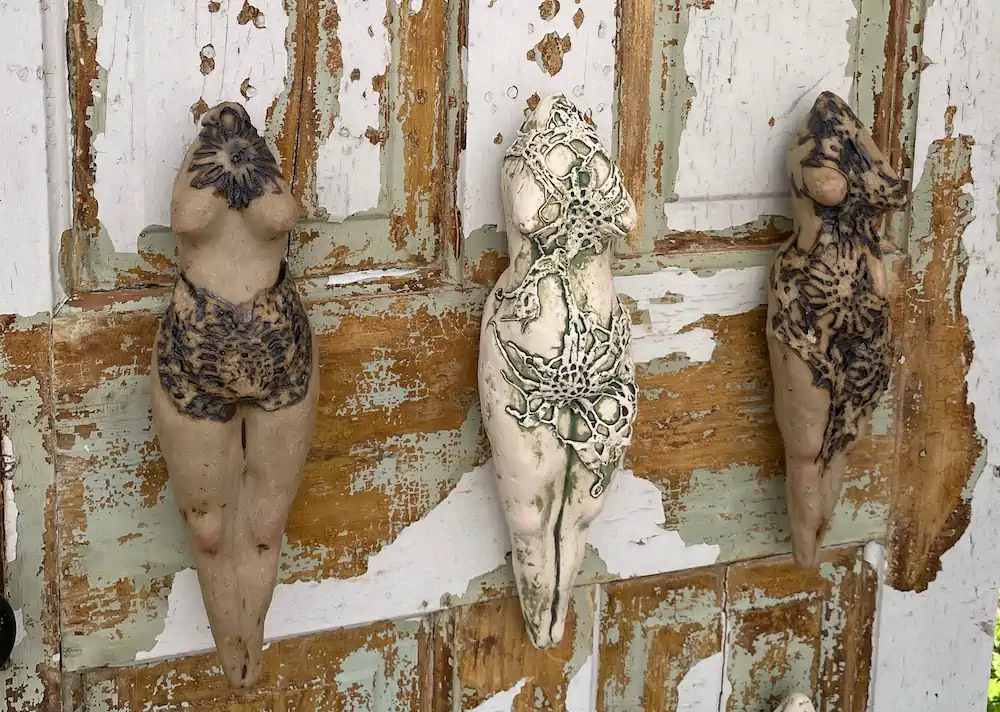
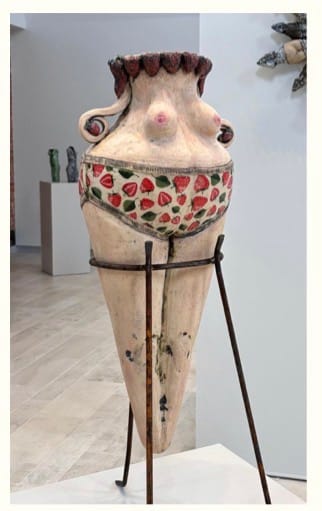
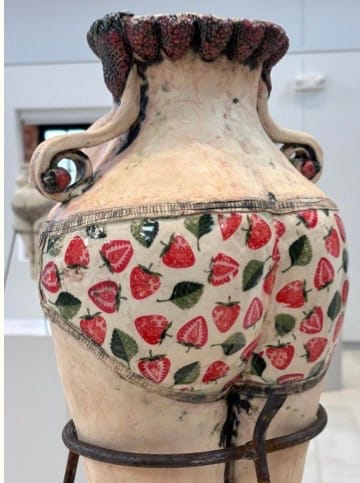
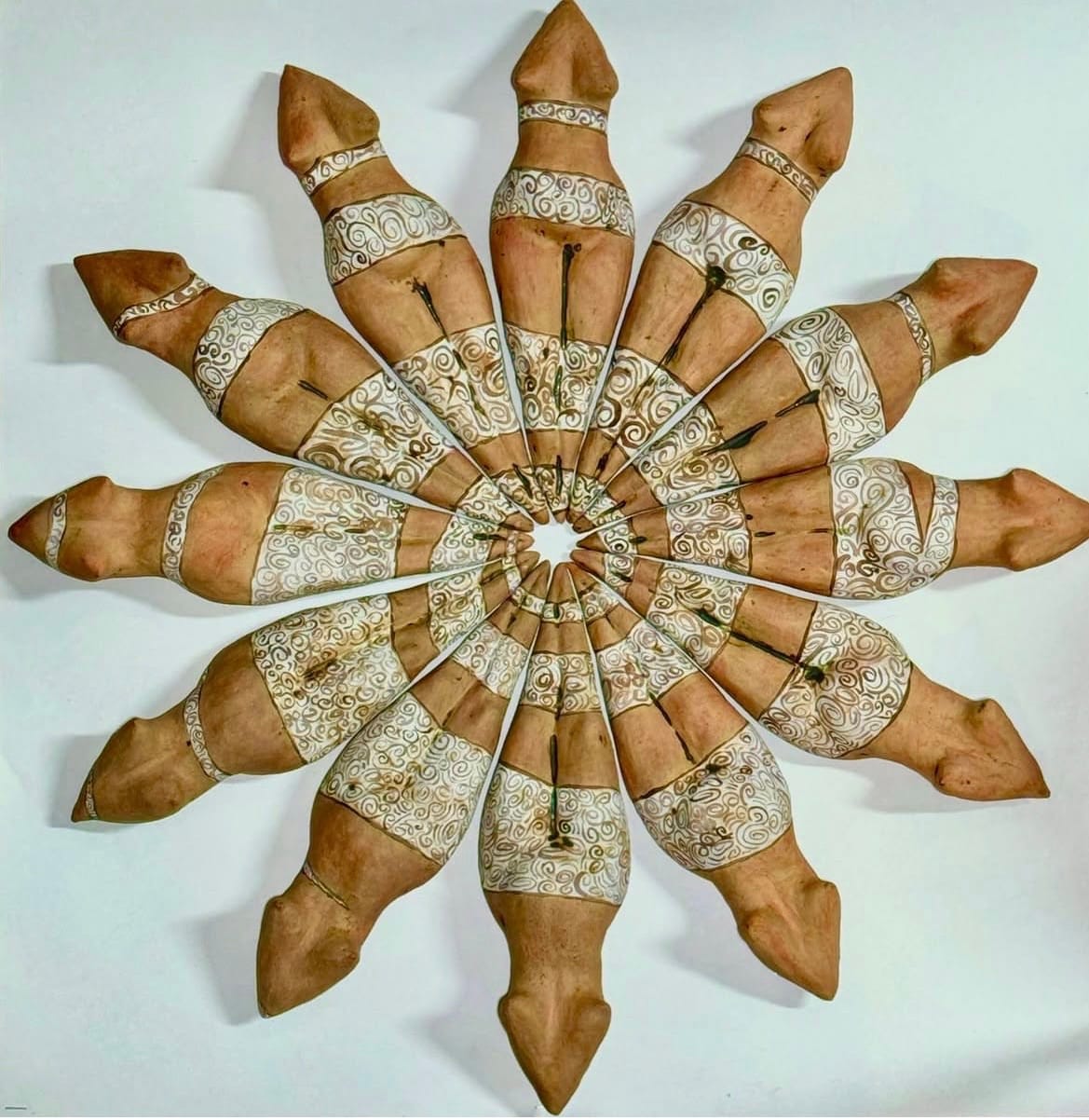
Ceramics by Kelly Chapin-Hagen.
Kelly Chapin-Hagen, Ceramicist, calls Sedalia, Missouri home. Her work continues to elicit murmurs and knowing kudos.