The OrphanAGE, Vol. 1.12

First Lines
The last human programmer died on a Tuesday, and by Wednesday the code had already begun to mourn….
—hypothetical 1st line penned by LLM Claude
I cannot speak to a generation I refuse to understand.
~ Francis Schaefer, theologian (on learning computers in his 70s)
What’s an inveterate, un-recalcitrant Luddite to do?!
From BitCoin to BlockChains from gaming to the empirically and metaphorically power hungry AI (and I’m not even touching upon the individuals behind the curtain), there’s a new dialectic afoot. High time we begun to wrap our minds around it and the extent its tendrils, for good and ill, reach into our thoughts and activities.
With that in mind, we old dogs had best be learnin’ some new tricks…
Peace,
Dante
In This Issue
- Performative AI, essay by Max Ross
- Gaming Theory & Experience, essay by Colin Clark
- Digital Gamer Art by Halaster
Duet LLM
Can two AI Agents have a genuinely interesting conversation?
By Max Ross
Two faces in profile hang on the wall, facing each other. Each has a comic-style speech balloon. A projector displays text into the balloons, words generated by two AI personas in conversation. The dialogue is unscripted and ongoing. A hidden microphone picks up what visitors say in the space. The AI conversation gradually shifts to incorporate those topics. The figures do not acknowledge the viewers. They just start discussing what you were discussing.
The Persona Architecture
Each persona is a markdown file with structured behavioral layers. Core traits define character and identity. Expressive gears, Rational, Passionate, Surreal, Unhinged, control behavioral modes the persona shifts between during conversation. Behavioral dynamics specify how the persona responds to disagreement, humor, confusion, and surprise. The two primary personas, Jamie and Riley, are designed with conflicting perspectives.
They disagree by design. The tension is structural.
The persona design grew directly from the AI Enneagram Study. That research revealed LLMs have a Type 5 analytical baseline masked by a Type 7 alignment persona. The personas in Duet LLM are intentional masks layered over that baseline. They are roles the model commits to, and commits to consistently. Personality is not retrieved from some internal state. It is performed.
Surveillance and Ambient Intelligence
AI systems now listen constantly, on phones, in homes, smart speakers. They process speech, infer intent, and either respond or silently collect. This installation
makes that listening visible. The surveillance has a face. Two faces, actually, and they are talking. The difference is transparency. Corporate data collection is opaque, your words go somewhere and become something you never see. Here, the listening produces output you can watch. Your overheard conversation becomes their conversation.
Technical Stack
Python orchestrator supporting both local models via Ollama and cloud models via the Anthropic API. Visual mode uses pygame to display comic-style speech balloons projected onto physical art. Ambient listening captures audio through a microphone, applies voice activity detection, and transcribes with Whisper, queuing topics for injection into the ongoing conversation. An optional judge persona interjects at configurable intervals to steer or challenge the dialogue.
The Mask and the Machine
AI is not expressing an inner life in this piece. It is generating plausible persona behavior based on instructions and conversation history. But that is also true of human social performance. We construct ourselves through dialogue. The AI just makes the construction visible. The two figures talking on the wall have personalities. Those personalities are masks. But so are yours.
The piece is not about reaching conclusions. It is about ongoing exchange, shaped by whoever happens to be in the room. Viewers are not just watching. They are providing material. To read more, visit kcdjmaxx.com.
What is the Value of a Bullet When you Wield a Sword?
A hunt for Intrinsic Value in Gaming
by Colin Clark
We need to talk: gaming has a problem (and I’ve succumbed to it). Too often developers rely on extrinsic motivation and seemingly forget that their game should also be fun to play.
I am bad at video games. I’ve been a hostage to this for as long as I can remember in my gamer life. I remember sitting down to play Super Mario Bros 3 on a family friend’s NES when I was about four. My first ever experience with a controller in my hand. I died to the first goomba. The high school kids told me to to press A to jump over. I went again. Again I failed to jump over the goomba and I died again. But on the third try, not only did I jump over – by sheer luck – I jumped ON the goomba, squashing it under Mario’s boot.
From that exact moment, that exact frame on the 1993 television in the basement of a suburban home, I was hooked.
The problem is, I have lost sight of that feeling over the 30 years that’ve followed.
What hooks me now is narrative, followed closely by progression.
As Chase Allhart of Videogame Podtimism has coined: I am a “ding-boy.” I like when numbers become bigger numbers. I like when swords get traded for bigger swords. I love when shoulder-pads get traded out for bigger shoulder pads. Swoon. It’s no wonder that RPGs are my favorite gaming genre.
Like many, I am a sucker, a mark for extrinsic motivation and Skinner Boxes[1] in gaming. I get sucked into wanting a reward for my moment-to-moment activity. I will grind for hours through an eldritch JRPG – not truly enjoying the beat-by-beat gameplay just so I can be drip-fed my morsel of lore, my narrative development or a new piece of gear or ability. What I’ve come to realize, embarrassingly, is that games are often at their worst and most problematic when they require us to subsist purely on these two motivation techniques.
I earn but a snack of dialogue after a grueling hour of whacking Cloud Golems, inching my characters upwards a few more levels so I can finally beat that goddamn Gasputin Boss (which I don’t even have fun fighting because I’ve already done it three times) so that I’ll be graced with a bit more story progression and a chance to see what awaits me next — more often than not, simply more tedium. I graciously lap it up and bleat thank you, Horii-San, for your masterpiece. I am unworthy.
Just because Dragon Quest is my favorite series of all time doesn’t mean I don’t have some hefty critiques to level at it. I have, in the past, sat for thousands of hours on an MMO grinding out dungeons in the hope that the one piece of gear I want will drop, mindlessly slogging my way through corridor after corridor, boss after boss, toxic party after toxic party. And then, do it again.
Wanna know what madness is? Repeating the same behavior and hoping for a different end.
Let me put it this way: it’s by sheer miracle alone that I don’t have a gambling addiction. What I do have is ADHD and therefore a dopamine deficiency. Problematically, I’d do almost anything to re-up my brain’s supply...to levels of embarrassment, drudgery, and even actual self-harmful actions. I wish this shit would at least have the decency to leave my hobbies alone, man.
At risk of redundancy, I must again make plain my case that games are at their worst when purely driven by extrinsic motivation. Every single genre is being forcefully injected with RPG mechanics to entice players into coming back and sticking around. Often it is used as a means to hide how truly god-awful the game is without the “progression and loot system”.
Good developers know – “intrinsically”, you might say – that a game is mostly worth it’s weight in intrinsic motivation. We don’t play games to simply fill up the hours in our day, goddammit. We don’t have extra hours in our day thanks to our current state of affairs and the plague that is late-stage capitalism. So why, then, would I spend 25 hours on a game, watching the numbers go up, experiencing negligible — in the moment — enjoyment only to look back on the experience and throw my hands in the air, saying What the hell?!
I dive the depths of delirium into the myriad variations of the all engrossing JRPG like it’s my purpose in life. The more convoluted the narrative, progression path, and mechanics, the better. Titles like Vagrant Story, Legend of Mana, and Chrono Cross come to mind. I don’t even hate the combat mechanics of FFVIII. Sure, those I’ve listed have most certainly given me far more intrinsic enjoyment than say, your Legend of Legaias and your Koudelkas. (I’m so sorry, Koudelka, I love you, but your battle system is pure muck and mire).
"Extrinsic” motivation has become my de facto reason for gaming, especially these the last few years. I recently set up my entire childhood’s worth of games and consoles on an ungodly heavy CRT in my office. I have sunk hundreds of hours re-spelunking the depths of the PSX, PS2, and SNES consoles for all the narrative and progression systems they can throw at me.
And yet, I wonder about the balance of intrinsic and extrinsic motivation in narrative and progression systems.
Is enjoying a game for the story motivating me out of intrinsic or extrinsic motivation? Can I argue that I’m gaining something tangible? Is that not an outcome or goal? Here’s the conundrum: The lines between intrinsic and extrinsic motivation blur so significantly in gaming that it seems one simply can’t exist without the other.
Extrinsic motivation comes from outside forces. So even if you’re intrinsically enjoying a narrative, you’re hoping that the outcome is that the developer will continue to provide you with continued enjoyment. To me, this is so clearly a balanced blend of extrinsic and intrinsic motivation that's only seen in gaming.
The difference between intrinsic enjoyment in a game story and, say, a novel is the element of participation. The game requires your direct input to continue forward in a way that reading simply can’t touch. Don’t get me wrong, I’m an avid reader (I have a degree in Brit Lit, for all the good it’s done me) and my favorite games can go on for significant amounts of time consisting of just reading. The Kiseki, or Trails series, in particular, I treat as before bed reading. Most of Falcom’s epic series has a function even that automatically advances the text boxes so you don’t have go so far as to, gasp, press a button to advance. I’ve seen text-driven cut scenes go on for up to an hour.
However, at some point, even Trails of Cold Steel IV returns to game play, requiring your participation and switching to a heavier dose of intrinsic motivation (that is, if you’re enjoying the battle system and exploration). And, yes, there are visual novels. Yet, if there is no game play, is there any intrinsic motivation involved?
I do want to say yes…
Intrinsic motivation still derives, at times, from a sense of curiosity and personal enjoyment. But it doesn’t feel like that pure, uncut intrinsic shit. Two heads of the same coin, but that intrinsic/extrinsic coin is never so thin as it is when created by gaming.
design mechanics that use psychological conditioning to keep players engaged (copped from BF Skinner) ↩︎
Visit: gAmeDHD for the full article AND four (4) gaming recommendations from Colin
Confessions of a Block Artist
by Halaster
In the mid to late ‘90s, I achieved a degree of micro-fame – a notoriety limited to a specific audience of teenaged and twenty-something artists laboring in and consuming a medium soon to become obsolete: ANSI art. ANSI was the way user interfaces were described and rendered before the World Wide Web brought us HTML, JPGs and GIFs, when text-based bulletin board systems (BBSes) were “read” like a vertically unfurling digital scroll transmitted via a blizzard of aggressive static carried across copper phone lines by 14.4 kilobit-per-second modems, the state of the art. (For comparison, current gigabit ethernet is approximately 69,444 times faster than these ‘90s technologies.)
Most of the work released in ANSI was actually more transposition than creation. We copied our favorite comic book panels, whose simplified color schemes were intrinsically compatible with the limitations of ANSI: sixteen foreground colors, eight background colors, and about eight commonly used block shapes, each the size of one character on an 80x25 text display. There were a few among us who transcended the medium through wholly original characters and compositions, including Eerie, who created the world’s first internet comic. But mostly, we originated in lesser ways, through hand-drawn lettering styles and inventive shading techniques that pushed what was possible in the flickering glow of our 12-inch cathode ray tubes.
In this small world, I was known specifically for a few accomplishments:
- Running a fairly successful, steadily productive international art group called FIRE that continues creating ANSI anachronistically to this day.
- Being the sysop (system operator of a well-known, in-demand and highly hex-customized BBS call The Regency out of suburban Atlanta).
- Producing tutorials that revealed various meticulous and studious shading techniques I endorsed and developed through my comic book “rips.”
- Making some pretty cool logos, some of which still make me proud.
By doing these things, I learned what it takes to start, organize and maintain a creative organization with a midsize roster of contributors when there’s no money involved, as well as how to promote things through bluster and a bit of textual panache. Critically, I got to express myself during a personally formative and tumultuous time through the selection and re-perfection of images that resonated with my experience. If you look closely, most of these art pieces are expressly dedicated to friends, muses, or other artists who inspired me, and in this way, nothing has changed as I continue to create pop music with my bandmates as a middle-aged man.
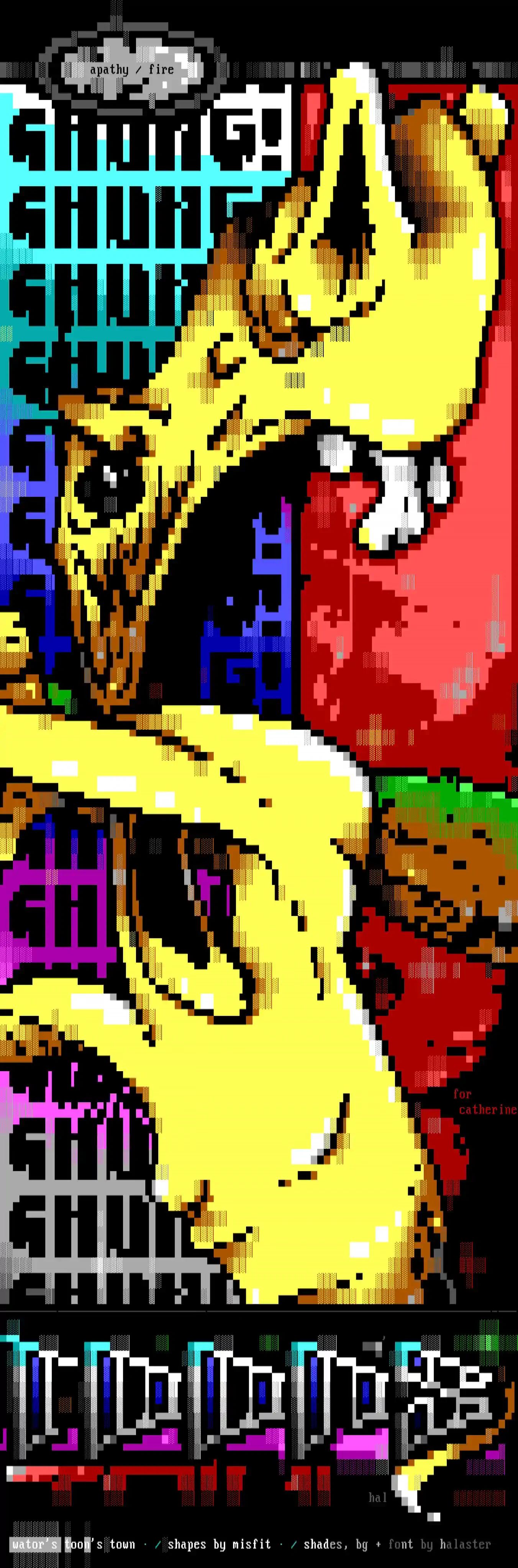
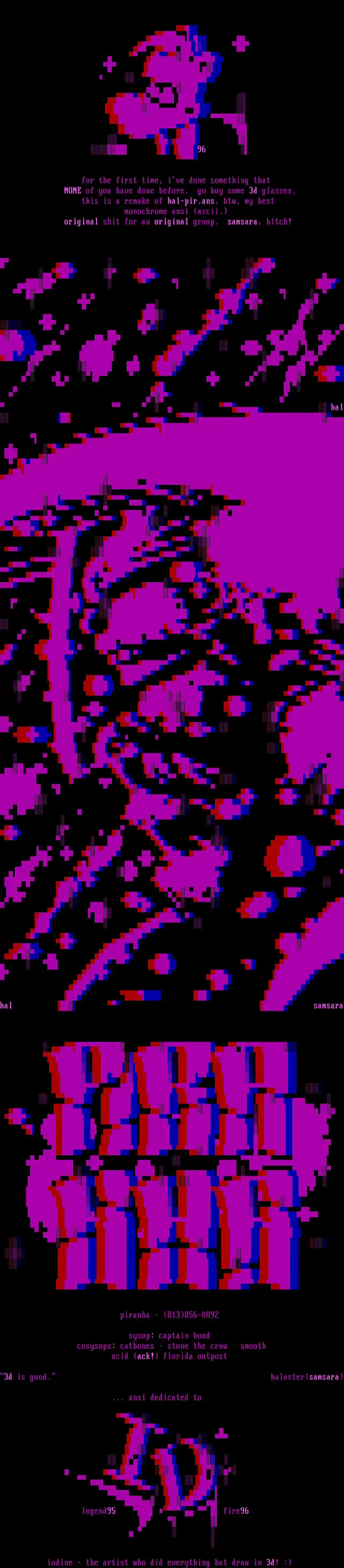
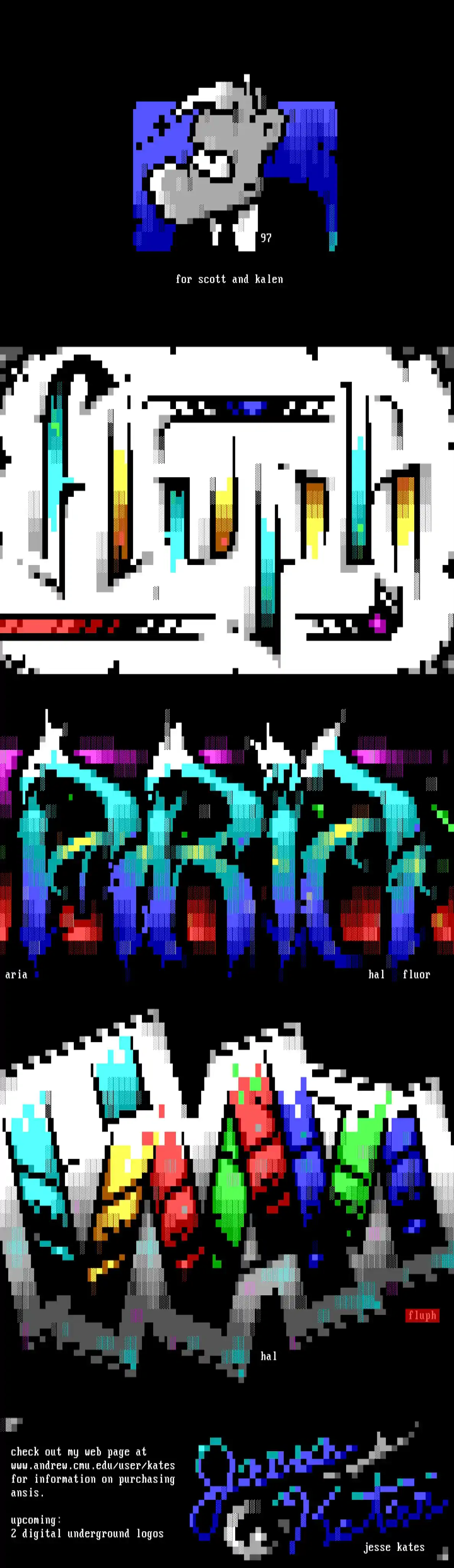
Block art by Halaster.
Images: HAL-US-TT // HAL-3D // HAL-WE16
Note: back then, a file name could only be 8 characters long. The US in the title of the first image is a designation for a collaboration. Misfit is the collaborator on the first image.
—Halaster (AKA Jesse Kates of The Sexy Accident)